Evolving Compliance: Insights into the Latest National Standards for Amusement Ride Safety
- Beston Amusement Rides
- Nov 3, 2025
- 5 min read
In recent years, the regulatory landscape for amusement ride design, manufacture, operation and inspection has undergone significant refinement. This article elucidates key elements of the current national-level standards, including those advanced by ASTM International (especially the F24 Committee) and International Organization for Standardization (ISO) via its ISO 17842 series. The focus will also touch upon how these norms apply to ride types such as the wave swingers and frisbee carnival ride, underscoring how compliance must adapt to their particular mechanical and human-factors requirements.
Scope and Significance of the Standards
The ISO 17842 series—specifically Parts 1 (design & manufacture) and 2 (operation & use) and Part 3 (inspection) — articulate uniform requirements for the safe engineering of amusement rides and devices. Meanwhile, ASTM’s F24 Committee promulgates voluntary consensus standards covering design (e.g., ASTM F2291-24) and operational / maintenance regimes (e.g., ASTM F770, ASTM F747). Though labelled “voluntary”, these standards are often incorporated into state or provincial regulatory regimes, making them de facto mandatory in many jurisdictions.
The significance of these standards cannot be overstated: they provide the structural, mechanical, human-interface and procedural backbone for rides which often subject riders to dynamic loads, rapid motion and complex control systems. Compliance mitigates risk, supports insurance eligibility, and ensures public and regulatory trust.
Design and Manufacture Requirements
Under the standards, design and manufacture represent the first layers of defence against failure. ISO 17842-1 defines minimum requirements for design, calculation, manufacture and installation. ASTM F2291-24 sets out criteria such as restraint systems, clearance envelopes, acceleration limits, loads/strength, control systems, and structural integrity.
For example, when designing a ride like a wave swingers – which engages in circular motion, pendulum swings and variable centrifugal effects – the engineer must evaluate the dynamic envelopes (i.e., spatial region swept by riders + components), restraint geometry, g-force limits, fatigue life of structural members, and redundancy of critical control systems. The standard mandates quantification of loads (static and dynamic), specification of safety margins, and documentation of failure modes.

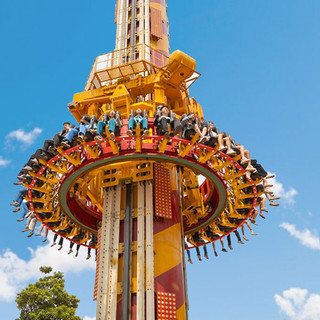
In a frisbee carnival ride scenario—where a large gondola oscillates pendulously and may rotate while carrying riders—the design team must ensure that the combined rotational and swinging motion does not exceed prescribed accelerations or produce rider discomfort beyond acceptable thresholds. Restraint systems must accommodate varied occupant sizes while maintaining containment under worst-case motion conditions.
Manufacturing protocols likewise demand traceability of materials, non-destructive testing of welds, verification of actuator/hydraulic/pneumatic systems, and adherence to quality control programs (e.g., ISO 9001). ASTM’s standards emphasize that design documentation and build records must be retained for lifecycle conformity.
Operation, Maintenance and Inspection Protocols
Design alone is insufficient without rigorous operational and maintenance oversight. ISO 17842-2 addresses operation and use of amusement rides, prescribing how rides should be used safely throughout their service life. The ASTM F770 standard (and others) cover ownership, operation, maintenance and inspection of rides and devices.
Key elements include:
Daily pre-operation checks: structural integrity, restraint function, control logic.
Periodic inspections: weekly, monthly, annual inspections guided by documented checklists.
Maintenance scheduling: lubrication, wear part replacement, structural assessment, electrical/hydraulic/pneumatic verification.
Record keeping: logs of inspection, maintenance, incident reports.
Operator training and certification: ensuring human-machine interface errors are minimised.
Specifically for a wave swingers ride, operators must monitor bearing wear, pivot-point fatigue, chain or cable condition (if used), and ensure that the centrifugal force generated does not exceed design limits under all load-scenarios. For a frisbee carnival ride, pendulum bearings, gondola rotation slip-ring assemblies, hydraulic actuators, and dynamic balancing are critical to maintain safe, smooth operation—standards demand periodic balancing and vibration checks.

Independent third-party audits are also recommended (and often mandated) to provide objective verification of operational readiness and compliance.
Inspection, Audit and Lifecycle Considerations
Inspection represents the bridge between manufacture and operation. ISO 17842-3 lays out requirements for inspection during design, manufacture, operation and use. In effect, it mandates that inspection regimes be systematic, documented, and executed by qualified personnel, with appropriate frequency, scope and technical capability.
The lifecycle of an amusement ride encompasses design, manufacture, installation, operation, major modification, up-to-and-including de-commissioning. Standards require that major modifications are treated as a redesign in many respects, triggering fresh analysis of loads, clearances and controls. For both wave swingers and frisbee carnival ride types, any modification to the gondola, drive system, or restraint mechanism triggers a full evaluation as per design standard. ASTM F2291-24 discusses major modifications explicitly.
Inspection protocols include structural weld quality, fatigue crack detection (via NDT methods), alignment checks, control system software verification, ride clearance envelope verification (especially if nearby attractions or terrain change), and emergency stop system verification. The standards imply a holistic auditing mindset—mechanical, electrical, hydraulic, human-factor—and demand formal documentation of non-conformities and corrective statuses.
Implications for Ride Types: Wave Swingers and Frisbee Carnival Ride
While the standards are generalised across ride types, their application must reflect the mechanical idiosyncrasies of each ride in question. For a wave swingers ride: the circular motion, elevation change and pendulum effect impose complex motion states. Designers must validate the occupant envelope as the seats lift and swing outward, pivoting around the main axis. Restraint design must account for outward centripetal forces and vertical elevation changes. Inspections must emphasise pivot wear, oscillation damping, seat mounting integrity, and chain/cable fatigue if present.
In contrast, a frisbee carnival ride blends pendular motion with full rotation of the gondola. That introduces multi-axial dynamics, requiring analysis of combined stresses: the pendulum drive torque, the gondola spin torque, inertial loads when fully inverted or in high amplitude swings. The standards compel that designers verify that the resultant vector accelerations remain within human tolerance thresholds, that restraint containment prevents ejection or partial ejection under peak loads, and that the clearance envelope remains clear of fixed structures, terrain, and other rides even under maximum amplitude motion. Operation protocols must account for load balancing (uneven seating can shift dynamic centre). Inspection must monitor slip ring electrical continuity, wear of pivot bearings under alternating load cases, and responsive emergency braking of both pendulum and gondola spin.
By applying the national standards with these ride-specific considerations, manufacturers, operators and safety officials convert generic requirements into concrete actions for these dynamic systems.
Challenges, Future Developments and Practical Compliance
The patchwork nature of ride regulation—especially in the United States—presents challenges. As noted in recent regulatory reviews, while many states reference ASTM standards, oversight varies widely. For operators and manufacturers, the practical imperative is two-fold: first, achieving normative compliance (using ASTM, ISO standards); second, achieving procedural robustness (inspection schedules, record-keeping, staff training).
Emerging trends in the standards landscape include increased digital instrumentation for ride monitoring, predictive maintenance via sensor networks, digital twin modelling of mechanical systems, and greater harmonisation of international standards (e.g., ISO 17842 aligning with EN 13814). For rides such as the wave swingers and frisbee carnival ride, this means that ride-specific data acquisition (load cycles, vibration signature) can feed into advanced maintenance regimes.
Practically, to comply:
Develop design dossiers referencing ASTM F2291, ISO 17842 parts.
For each ride model, conduct dynamic simulation (FEM, motion modelling) to verify compliance.
Establish inspection/maintenance logs consistent with ASTM F770 / ISO inspection parts.
Provide operator training and access to emergency procedures.
Engage independent third-party auditors and calibrate to jurisdictional requirements.
Be alert to modification triggers: any structural, mechanical or control system alteration must re-invoke design review.
Maintain a proactive risk-management mindset: review near-misses, incident reports, and leverage them to refine procedures.
Conclusion
The latest national standards for amusement rides form an integrated architecture of safety from design through operation to decommissioning. For ride types such as wave swingers and frisbee carnival ride, these norms translate into ride-specific imperatives: dynamic load verification, complex motion modelling, rigorous inspection protocols, and operational discipline. Compliance is not static; it demands ongoing vigilance, documentation, and adaptation as rides age or are modified. By aligning with ASTM and ISO standards—and embedding those requirements into practical workflows—operators and manufacturers render the thrill of amusement rides into a framework of predictable safety rather than precarious chance.
In short: the regulatory frameworks exist, the mechanical systems demand precise implementation, and the human factors of operation and inspection complete the chain. The responsibility is distributed—and the outcome must be unequivocal: safe, exhilarating, and reliable ride experiences.


Comments